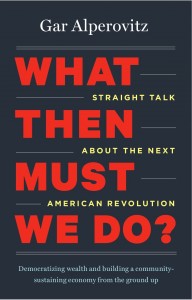
My new film: available now My new book: order now

Ownership, Full Employment and Community Economic Stability

This article originally appeared as a guest post on Robert Pollin’s “Back to Full Employment” blog.

The great British economist the late Joan Robinson once observed that the only thing worse than being exploited by capitalism is not being exploited by capitalism. This truth is felt acutely by anyone who is unemployed and looking for work. As the pain of the economic crisis continues and millions struggle to find employment there is an obvious imperative to create jobs—any jobs. But we shouldn’t stop there. In Back to Full Employment, Robert Pollin makes the essential point that “a workable definition of full employment should refer to an abundance of decent jobs.” Poor jobs that keep workers minimally employed but leave them in precarious circumstances and unable to participate fully in civic and political life are better than no jobs at all. But in terms of public policy we can and should aim higher—especially as decent jobs not only benefit the workers that hold them but also the communities in which they live. Absent a stable economic base, community itself is compromised. Read More »

Posted in Articles | Leave a comment

6 Economic Steps to a Better Life and Real Prosperity for All

This article originally appeared on Alternet

Most activists tend to approach progressive change from one of two perspectives: First, there’s the “reform” tradition that assumes corporate control is a constant and that “politics” acts to modify practices within that constraint. Liberalism in the United States is representative of this tradition. Then there’s the “revolutionary” tradition, which assumes change can come about only if the major institutions are largely eliminated or transcended, often by violence.

But what if neither revolution nor reform is viable?

Paradoxically, we believe the current stalemating of progressive reform may open up some unique strategic possibilities to transform institutions of the political economy over time. We call this third option evolutionary reconstruction. Like reform, evolutionary reconstruction involves step-by-step nonviolent change. But like revolution, evolutionary reconstruction changes the basic institutions of ownership of the economy, so that the broad public, rather than a narrow band of individuals (i.e., the “one percent”) owns more and more of the nation’s productive assets.

1. A People’s Bank

One area where this logic can be seen at work is in the financial industry. At the height of the financial crisis in early 2009, some kind of nationalization of the banks seemed possible. It was a moment, President Obama told banking CEOs, when his administration was “the only thing between you and the pitchforks.” The president opted for a soft bailout, but that was not the only possible decision. Read More »

Posted in Articles, What Then Must We Do? (News and Updates) | Leave a comment

A Checkerboard Strategy for Regaining the Progressive Initiative

President Obama is Time magazine’s “Person of the Year” – the first Democratic president to receive two consecutive popular-vote majorities since Franklin Delano Roosevelt. Yet these are clearly tough times for progressives. Everything progressives have fought for is seemingly on the chopping block nationally, and in many states and cities. Programs are being cut; public assets are being sold off; school teachers are losing their jobs; unions are being attacked; pension and health care benefits are being slashed – even Social Security is being challenged.

Progressives, in short, remain on the defensive.

No one would deny that defense is important. But even as every effort must be made to hold the line, how, specifically, might it be possible to regain the political initiative?

History suggests one powerful strategy – one that begins by getting clear about the checkerboard of power, and its possibilities.

Read More »

Posted in Articles, Resources for The Next American Revolution, What Then Must We Do? (News and Updates) | Leave a comment

Wall Street Journal More Interested in Caviar and Foie Gras Than Worker Ownership

Social pain, anger at ecological degradation and the inability of traditional politics to address deep economic failings has fueled an extraordinary amount of practical on-the-ground institutional experimentation and innovation by activists, economists and socially minded business leaders in communities around the country.

A vast democratized “new economy” is slowly emerging throughout the United States. The general public, however, knows almost nothing about it because the American press simply does not cover the developing institutions and strategies.

For instance, a sample assessment of coverage between January and November of 2012 by the most widely circulated newspaper in the United States , the Wall Street Journal, found ten times more references to caviar than to employee-owned firms, a growing sector of the economy that involves more than $800 billion in assets and 10 million employee-owners — around three million more individuals than are members of unions in the private sector.

Worker ownership — the most common form of which involves ESOPs, or Employee Stock Ownership Plans — was mentioned in a mere five articles. By contrast, over 60 articles referred to equestrian activities like horse racing, and golf clubs appeared in 132 pieces over the same period.

Read More »

Posted in Articles, Resources for The Next American Revolution, What Then Must We Do? (News and Updates) | 1 Comment

Podcast: How System Change Can Come To America with Gus Speth

On September 19, 2012, the New Economy Working Group hosted a discussion and question-and-answer period regarding the possibilities of introducing system change in the context of the United States.

Featuring Gar Alperovitz and James “Gus” Speth, formerly a presidential advisor, Administrator of the United Nations Development Program and dean of Yale Forestry School, the discussion was moderated by John Cavanagh, director of the Institute for Policy Studies.

Listen now:

Download this segment

[Subscribe on iTunes * Podcast link]


Posted in Audio and Video, Gar Alperovitz Podcast | Leave a comment