 AMERICA BEYOND CAPITALISM
This interview originally appeared in Truthout on June 8, 2013.
By Gar Smith, The Berkeley Daily Planet
Gar Alperovitz, currently a Professor of Political Economy at the University of Maryland, has been writing books about wealth, democracy and national security for 48 years. In addition to serving in several government posts (including Special Assistant in the US State Department), Alperovitz is a founding principle of The Democracy Collaborative and a boardmember at the New Economics Institute.
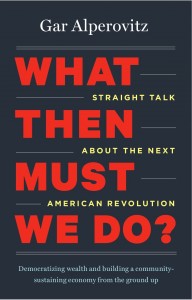
What Then Must We Do? (his latest book and his twelfth since 1965) is a breezy, conversational read filled with somber forecasts, hopeful alternative economic strategies and lots of surprising facts and stats (Some examples: If the nation’s personal wealth were divided evenly, a family of four would receive $200,000 a year. The hourly US minimum wage, adjusted for inflation, is now $2 less than it was in 1968. The US is such a large country “You can tuck Germany into Montana!”)
What Then Must We Do? (the title is borrowed from Tolstoy) explores a challenging premise: “The coming painful decades may be the prehistory of the next American revolution – and an evolutionary process that transforms the American system, making it both morally meaningful and ecologically sustainable.”
Daniel Ellsberg calls this book possibly “the most important movement-building book of the new century” and Juliet Schor, author of True Wealth, hails it as “the most compelling account yet of how we can move beyond the piecemeal, project–by–project transformation of our political economy to truly systemic change.”
Alperovitz recently took time from his busy schedule to discuss the arguments in his new book and explore the ramifications of social and economic change in an era of pending systemic collapse.
Gar S: You point out that 400 plutocrats in the US now own more wealth than 180 million other Americans. A scale of inequality that ranks as “medieval.” Shortly before his assassination, Dr. King noted America’s problems could not be solved without “undergoing a radical redistribution of economic power.”
Gar A: The concentration of wealth in this country is astonishing. 400 individuals—you could seat them all on a single airplane—own as much wealth as 60 percent of the rest of the country taken together. I was describing this distribution as “medieval” until a medieval historian set me straight: wealth was far more evenly distributed in the Middle Ages. When you ask where power lies in our system, you are asking who owns the productive assets. And that’s the top 1 percent—in fact, the top 1 percent of the 1 percent. It is a feudalistic structure of extreme power. It is anathema to a democracy to have that kind of concentration of wealth. More and more people are beginning to realize the extent and reach of corporate power and the power of those who own the corporations. The Koch brothers get a lot of publicity, but it’s a much wider phenomenon.
You mentioned Martin Luther King, citing some of the quotes I included in the book. This year marks the fiftieth anniversary of his legendary “I Have a Dream” speech at the Lincoln Memorial, and we will be doubtless be hearing a lot about that and Dr. King’s leadership on racial equality and civil rights. I worked with him on neighborhood ownership questions we were looking at in the Senate at the time; and then again, a few years later, when he came out against the Vietnam War. He was also questioning the distribution of wealth, citing the “triple evils” of racism, economic exploitation and militarism. At the end, right before he was assassinated, he even began to talk about changing the economic power structure, even occasionally, using the words “democratic socialism.” In this era of difficulty we would do well to remember Dr. King as a visionary who was beginning to step out beyond the cramped consensus to ask far deeper questions about the nature of America and the possibilities for a different future for this country. That is our challenge today.
Gar S: You argue that it was not politics but circumstance (the Great Depression, followed by WW II) that precipitated the New Deal’s progressive change and the country’s post-war economic prosperity. I was surprised by your assessment that an economic collapse on the scale of the Great Depression is no longer likely. Could you explain?
Gar A: Despite the systemic problems a crisis collapse of the scope and scale of the Great Depression is not likely. Here are a few reasons. First, the size of ongoing government spending stabilizing the economy is much, much larger than it was at the time of the Great Depression. Government spending—the floor under the private economy, if you like—was at 11 percent in 1929, now it is roughly 30 to 35 percent of the economy (depending on the year, and whether we are in recession.) The economy may decline rapidly, but the floor is three times higher than it was during the 1930s. Second, today we have built-in economic “stabilizers”—spending that kicks in to help offset the decline when recessions begin to get underway: unemployment insurance, food stamps, and so on. Then there is the sea change in politics. The American public now holds political leaders responsible for making sure the economy works—or at least does not totally fail. There is a heavy political price for any politician who fails to deal with truly massive economic pain. Perhaps most importantly, when push comes to shove, major corporate leaders also support action to counteract truly major economic contractions. You saw it in 2008 and 2009 when business leaders demanded action—including the stimulus plan.
So massive and sustained economic collapse of the kind that opened the way for extremely unusual and far-reaching policy change in the Great Depression and New Deal era, though not impossible, is no longer likely. This is not to say great recessions, ongoing economic pain, and high unemployment may not occur for long periods of time. Indeed, that is what we face at present.
Gar S: The new word for economic performance is no longer “growth” but “stagnation.” One percent of the country controls so much wealth but—unlike the middle class and working poor—the rich don’t spend a significant part of their wealth.
Gar A: This prospect of stagnation—or “punctuated stagnation,” as I write (there may be small intermittent upticks; plus oil and other commodity price explosions)—is very important to grasp. I believe (along with many observers) that we are entering an era of deepening stagnation and political stalemate. One problem is lack of demand in Keynesian terms, but I think it’s far deeper than that. We are returning to a pattern of stagnation that was common before the Depression collapse, on the one hand, and the extremely unusual conditions that prevailed during the postwar economic boom, on the other.
A short form of the argument would be this: in the first quarter of the twentieth century, up to World War I, there was decay, decline, and indeed major recession and almost depression. We don’t know what would have happened; World War I intervened, bailing out the economy. Same story with the Great Depression: World War II, not the New Deal, solved the economic problem in the second quarter of the century. In the third quarter of the century the post-war economic boom—brought about partly by savings built up during the war, partly by military spending in the Korean War, Vietnam War, and the big military budgets of the Cold War, and partly because US competitors (Germany, Japan, and many others) had been significantly destroyed—was an extremely unusual boom moment—the greatest sustained boom in our history. But thereafter the pattern of economic difficulty resumed in the final quarter of the century. Even though military budgets are high today in absolute terms, they are comparatively small as a share of GDP. And I think nuclear weapons now preclude an industrial-scale global war like World War I or World War II. We can have small horrible wars, but they don’t function economically in the way that larger wars did previously.
Now these difficulties could be resolved if you had sufficient political power to mount a traditional Keynesian solution. But what is significant—and this is the heart of the matter—is that such a solution is no longer available, politically, for a number of reasons. I could go into a lot of them, but the principal one is the decline of organized labor. Labor union membership, the muscle behind progressive politics, was at its peak of around 35 percent just after the war, but is now down to the 11 percent range (and the 6 percent range in the private sector). Liberal reform now lacks an institutional basis. So that’s a picture of decay, and there doesn’t seem to be an easy way out.
Gar S: You argue that “evolutionary reconstruction” does not flow from reform or revolution but rather “from building institutions, workplaces and cultures concerned with democratizing wealth.” How significant are cooperative enterprises in today’s economy. Could you describe the current state of America’s cooperative economy?
Gar A: Given that the economy is unlikely to truly collapse and provoke explosive change—for all the reasons I have indicated—and given that a “reform” solution like the New Deal is extremely difficult in the absence of a strong institutional power base for liberalism (e.g. labor unions), we face an extremely unusual political situation. I believe we are entering an extended period, a multi-decade period, in which the dominant reality is likely to be one of erratic growth, stagnation, periodic inflation, substantial political stalemate and decay.
In such a context, the prospects for near-term change are obviously not great—especially when such change is conceived in traditional terms. On the other hand, for precisely such reasons, there is likely to be an intensified process of much deeper probing, much more serious political analysis, and much more fundamental institutional exploration and development. In fact, this is already well underway. Beneath the surface level of politics-as-usual, continuing political stalemate and the exhaustion of existing approaches have begun to open up some very interesting strategic possibilities. These are best understood as neither “reforms” (policies to modify and control, but not transcend, current corporate-dominated institutions) nor “revolution” (the overthrowing of current institutions), but rather a longer-term process of “evolutionary reconstruction”—that is, institutional transformation that unfolds over time.
Like reform, evolutionary reconstruction involves step-by-step nonviolent change. But like revolution, evolutionary reconstruction changes the basic institutions of ownership of the economy, so that the broad public (rather than “the one percent”) increasingly comes to own more and more of the nation’s productive assets. As the old system decays, an evolutionary reconstruction would see the foundations of a new system gradually rising and replacing failing elements of the old.
Though the press doesn’t much cover this, such processes are already observable in many parts of the current American system. Some numbers: There are now ten thousand worker-owned companies of one kind or another in the country. And they are expanding over time, and they’re becoming more democratic rather than less. There are 130 million people who are members of one or another form of cooperative. A quarter of American electricity is produced by either municipal ownership or cooperatives. Twenty-five percent of American electricity is, in other words, “socialized.” There are neighborhood corporations, land trusts, and other municipal and state strategies. One can observe such a dynamic developing in the central neighborhoods of some of the nation’s larger cities, places that have consistently suffered high levels of unemployment and poverty. In such neighborhoods, democratizing development has gone forward, paradoxically, precisely because traditional policies have been politically impossible.
All this has been building in scale and sophistication to the point that growing numbers of people now talk about a “New Economy.” It doesn’t yet compare to the giants of Wall Street and the corporate economy, of course. But it is growing to the point where challenges are also becoming possible. Move Your Money campaigns have seen billions transferred out of Wall Street banks into credit unions and local and community banks. If you add up the credit unions they are the equivalent of one of the largest US banks, knocking Goldman Sachs out of the top five.
I see this era as something akin to the decades before the New Deal, the time when experimentation and development in the state and local “laboratories of democracy” laid down the principles and programs that became the basis for much larger national policies when the right political moment occurred.
Gar S: You clearly show that regulating Wall Street doesn’t work and breaking up large banks is unlikely to last. The conservative Chicago School of Economics, you point out, had a solution: essentially any business “too big to regulate”” should be nationalized. “Take them over; turn them into public utilities.” Could large banks really be taken over and transformed?
Gar A: The old conservative economists were right: Regulation doesn’t work; they capture the regulators. Anti-trust doesn’t work; if you break them up, they re-group. Look at Standard Oil. Look at AT&T and the telephone companies. In fact, the major banks are even bigger now than they were in 2008 when they were deemed “too big to fail.” They imperil the entire economy. So ultimately the only answer, logically, is to take them over at some point. Milton Friedman’s revered teacher, H.C. Simons, the founder of the conservative Chicago School of economics, was one of the first to point out this logic. He argued that this was necessary because it was the only way to preserve a genuinely free economy.
Can it be done? We just did it in one form: In response to the financial crisis the federal government essentially nationalized General Motors and A.I.G. and was in a position to do the same with Chrysler and several major banks because of the huge injections of public capital that were required to save them from bankruptcy. At one point, Obama frankly told the bankers that he was the only one standing between them and the pitchforks. What happens when the next financial crisis occurs (as most observers on left, right and center think inevitable)? Or the one after that?
There are also already alternative models at hand. Most people don’t realize this, but the federal government currently runs 140 different government banks. They aren’t always called banks, although sometimes they are, like the Export-Import Bank and the National Cooperative Bank. But sometimes they take the form of small business loans programs or agricultural programs. Then there is the Bank of North Dakota, a public bank that has been there for ninety years. It’s a state-owned bank, very popular with small business but also labor. Twenty states have introduced legislation to create public banks of their own. States have huge tax flows, which could capitalize such banks. Once you start to look more carefully, beneath the surface of media attention, it may be that far more is possible much earlier and much faster than many now imagine.
Gar S: If you don’t like corporate capitalism or state socialism, what’s left? Shouldn’t a fundamental goal be to prevent accumulations of great wealth. Once great wealth or power is attained, there is a tendency to fear the majority and seek to protect one’s fortune at all costs.
Gar A: That is a fair question, and most people don’t face it squarely: “If you don’t like corporate capitalism, where the corporations dominate the political system, and you don’t like state socialism, where the state dominates the system by virtue of its ownership, what do you want?” I think the developments reported on in the book point towards something very American, something that might be called “a community sustaining system”—one in which national structures and regional structures and local structures are all oriented to producing healthy local community economies, and thereby healthy and ecologically sustainable democratic communities.
We are at a very remarkable moment in American history: Even as we face massive economic, social and environmental challenges, more and more people are beginning to see that politics as usual doesn’t work, that the problems are fundamental to the system itself. These issues are on the table for the first time in many decades. So there needs to be an answer at some point, in terms of system design, to the question of what a system looks like that isn’t corporate capitalism and isn’t state socialism but begins with community and how we build it.
The truly central question is who gets to own the nation’s wealth? Because it’s not only an economic question, it determines politics in large part. The corporate capitalist system lodges such power in the corporations and tiny elites. An alternative system must begin at the bottom and democratize ownership from the bottom up—all the way from small co-ops and neighborhood corporations on up through city and state institutions and even, when necessary, regionally and nationally.
I think we can see the outlines of such a model already emerging in developments in the New Economy. It might be called a “Pluralist Commonwealth.” Plural forms of common wealth ownership. Worker ownership, co-ops, municipal utilities, neighborhood land trusts, state ownership of certain national firms. Plural forms. It’s not very sexy language, but it attempts to get to the idea that you must change ownership of wealth in many different ways in order to achieve democratic results and achieve cultural changes that allow us a democratic solution to the systemic problem. The key thing is that just below the surface of media attention a great deal is going on—many, many new developments that move in the direction of democratic ownership, starting at the very grass roots level, and moving up.
All of this ultimately also puts “the system question” on the table. We need a serious and wide-ranging debate around a broader menu of institutional possibilities for America’s future than the stale choices commonly discussed on both left and right.

 Agenda
 Posterboard
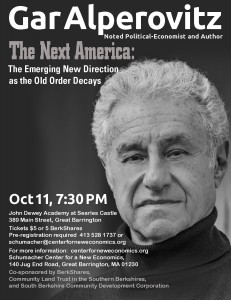 On Friday evening, October 11, 2013, political economist Gar Alperovitz will give a talk at the John Dewey Academy at Searles Castle in Great Barrington titled: