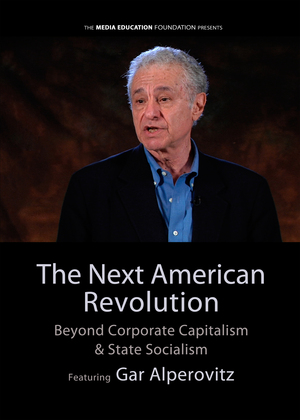
My new film: available now My new book: order now
Gar Alperovitz is the author of What Then Must We Do?, America Beyond Capitalism, and The Decision to Use the Atomic Bomb, and an advocate for a new, community-sustaining economy.

Congratulations to the workers of the New Era Windows Cooperative!

Congratulations to the workers of the New Era Windows Cooperative, now open for business in Chicago! Their story is inspiring: two separate occupations of their factory in a day and age when such militancy in the labor movement is assumed to be a thing of the past, not to mention a long fight to get Serious Energy (the second employer to close down their workplace) to agree to sell them the equipment they’d need to restart production.

They had help from powerful allies in UE, the union that helped them organize the two occupations as well as the cooperative buyout—and from the Working World, an innovative lender supporting worker cooperatives both in the US and in Latin America, where a wave of factory “recuperations” erupted in the wake of Argentina’s financial collapse in 2001.

For me, the story of New Era is a dramatic symbol of a choice we face at this moment in history:

On the one hand; long running decay, with jobs continuing to leave communities as employers chase higher margins around the globe—and ongoing and persistent decaying crisis in a stagnant and unstable economy disproportionately played out on the backs of the poor, especially in communities of color.

On the other hand: the possibility of something else, of a movement to rebuild the economy with democracy—and democratized ownership—at its core, helping anchor jobs and workers to communities and vice versa, addressing at a structural level the rampant and corrosive inequality that pervades our contemporary society.

Such long term evolving systemic transformation is neither quick nor easy. The dedication of the New Era workers, their refusal to give up and “go quietly”, their willingness to stake their futures on a democratic workplace, points towards something important: if we are serious about building a “new economy,” we need to be prepared for a long fight. Not all of the quietly developing experiments with worker, community, and public ownership taking off around the country today are likely to encounter such dramatic tests of faith as those met—successfully—by the workers who today opened the New Era Windows cooperative. Their example, however, and their courage, are examples of the kind of thing we all need learn from as the developing trajectory of new economic democratization and change continues to evolve.
Read More »

Posted in Articles | Comments closed

Video from my book talk at Seattle’s Elliot Bay Books

Posted in Audio and Video, Uncategorized, What Then Must We Do? (News and Updates) | Comments closed

When Martin Luther King Came to Cambridge: An Historic Conversation about an Historic Moment

vietnam-summerwith LANI GUINIER * GAR ALPEROVITZ * BYRON RUSHING

There can be no freedom without peace and no peace without justice.

—Dr. Martin Luther King, Jr, in Cambridge, Massachusetts, April 22nd, 1967

Monday, May 20th 7:00PM

Christ Church Cambridge, Zero Garden Street, Cambridge

This year marks the 50th anniversary of Martin Luther King’s legendary “I Have a Dream” speech at the Lincoln Memorial in Washington, an anniversary that is going to be marked by celebrations and commemorations nationwide this summer.

But four years after he gave that speech, Rev. King came here to Cambridge, to Harvard Square, with a different message for America: one not about a dream of equality of rights but the dangers of war. The war in Vietnam was killing and maiming young Americans at an astonishing rate and the casualty rates for black soldiers were far higher than for whites. At home, President Johnson and the Congress were cutting precious funding for the War on Poverty in favor of the War in Vietnam.

America, King feared, was being both wounded and corrupted by what was happening 9,000 miles away; so he came to Cambridge to issue a new call, one as important in some ways as his “I Have a Dream” speech, one that would link the civil rights and antiwar and antipoverty workers across the nation in a new common crusade for justice, equality, and peace.

But why Cambridge? And what did King say? What did he hope to achieve?

On Monday, May 20th, at 7PM, join Harvard professor Lani Guinier, co-founder of Vietnam Summer Gar Alperovitz, and State Representative Byron Rushing, a legendary civil rights and antiwar legislator here in Massachusetts in an intimate conversation as they discuss “When Martin Luther King Came to Cambridge….”

Forty years after Dr. King spoke, part of his dream was met: America elected its first African-American President. But what else remains to be realized? And what of Dr. King’s challenge in Cambridge has been taken up by Barack Obama, and what not? What linked civil rights, antiwar, and antipoverty efforts into a common cause in Dr. King’s mind that day in Cambridge and how are each of them faring today?

By special arrangement, the conversation among Lani Guinier, Gar Alperovitz, and Byron Rushing takes place in the very room at Christ Church Cambridge where Rev. King issued his challenge. Join them as they reflect on his legacy and its importance today.

Seats are limited for this historic event, but it is free and open to the public.

Street parking available. Harvard Square Red Line T stop one block away.

Parish Hall doors open at 6:45PM.

More information about Vietnam Summer: Vietnam Summer Evolves From Phone Call To Nation-Wide Organizing Project

Posted in Uncategorized | Comments closed

The Question of Socialism (and Beyond!) Is About to Open Up in These United States

Little noticed by most Americans, Merriam Webster, one of the world’s most important dictionaries, announced a few months ago that the two most looked-up words in 2012 were “socialism” and “capitalism.”

Traffic for the pair on the company’s website roughly doubled from the year before. The choice was a “kind of no-brainer,” observed editor at large, Peter Sokolowski. “They’re words that sort of encapsulate the zeitgeist.”

Leading polling organizations have found converging results among younger Americans. Two recent Rasmussen surveys, for instance, discovered that Americans younger than 30 are almost equally divided as to whether capitalism or socialism is preferable. Another Pew survey found those aged 18 to 29 have a more favorable reaction to the term “socialism” by a margin of 49 to 43 percent.

Note carefully: These are the people who will inevitably be creating the next American politics and the next American system.

As economic failure continues to create massive social and economic pain and a stalemated Washington dickers, search for some alternative to the current “system” is likely to continue to grow. It is clearly time to get serious about a different vision for the future. Critically, we need to be far more sophisticated about what a meaningful “systemic design” that might undergird a new direction (whether called “socialism” or whatever) would entail.

Read More »

Posted in Articles, Resources for The Next American Revolution, Resources for What Then Must We Do? | Comments closed

Kind words from Monthly Review on my work and new book

From the editor’s introduction to the April 2013 issue (http://monthlyreview.org/2013/04/01):

One of the most notable left intellectuals in the United States is Gar Alperovitz, professor of political economy at the University of Maryland. As an undergraduate Alperovitz studied at the University of Wisconsin under the great revisionist historian William Appleman Williams (a frequent contributor at the time to Monthly Review). He went on to pursue a PhD in economics at Cambridge University under Joan Robinson (also an MR contributor). Alperovitz’s doctoral dissertation, which was eventually published as the book Atomic Diplomacy, constituted a revisionist historical account of the decision to drop the atomic bomb on Hiroshima and Nagasaki. He demonstrated that Truman’s decision to use the bomb on civilian populations was opposed by U.S. military leaders—and was not so much the last act in the Second World War as the first act in the Cold War. (Truman’s objective in dropping the bomb was to force an immediate unconditional surrender—Japan had offered to surrender but the security of the emperor remained a sticking point—in order to preempt the further advance of Soviet troops into Asia and the expansion of the Soviet sphere of influence.) Alperovitz’s latest initiative is represented by his brand new book,What Then Must We Do?: Straight Talk About the Next American Revolution. He describes the systemic crisis in which the United States is trapped as one of “punctuated stagnation”: The nature of our current economic predicament, he writes, “is not [one of] collapse, but rather an odd form of painful stagnation—the hallmark of which is economic decay, with occasional significant downturns and (at best) modest and temporary upticks around a sickening, uncertain and debilitating norm” (126). […] We strongly agree with Alperovitz that a “punctuated stagnation,” in the sense he has described it, is the most accurate reading of contemporary economic reality and sets the stage for what could be “the next American revolution.” His book can be obtained from Chelsea Green Publishing at http://chelseagreen.com.


Posted in What Then Must We Do? (News and Updates) | Comments closed