My talk at Town Hall Seattle:
And at SOCAP 2012 in San Francisco:
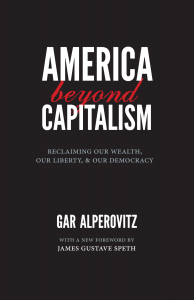
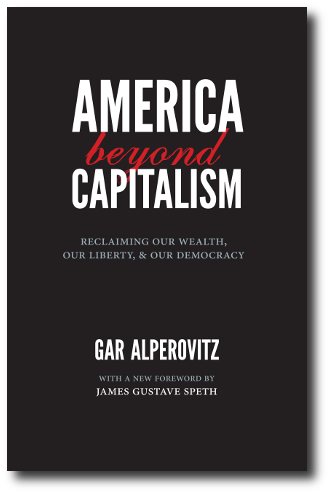 AMERICA BEYOND CAPITALISM
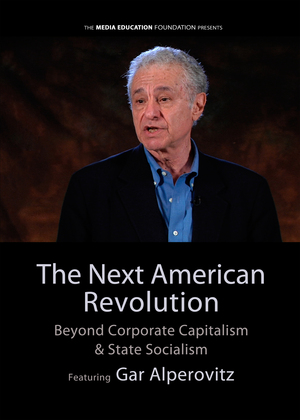
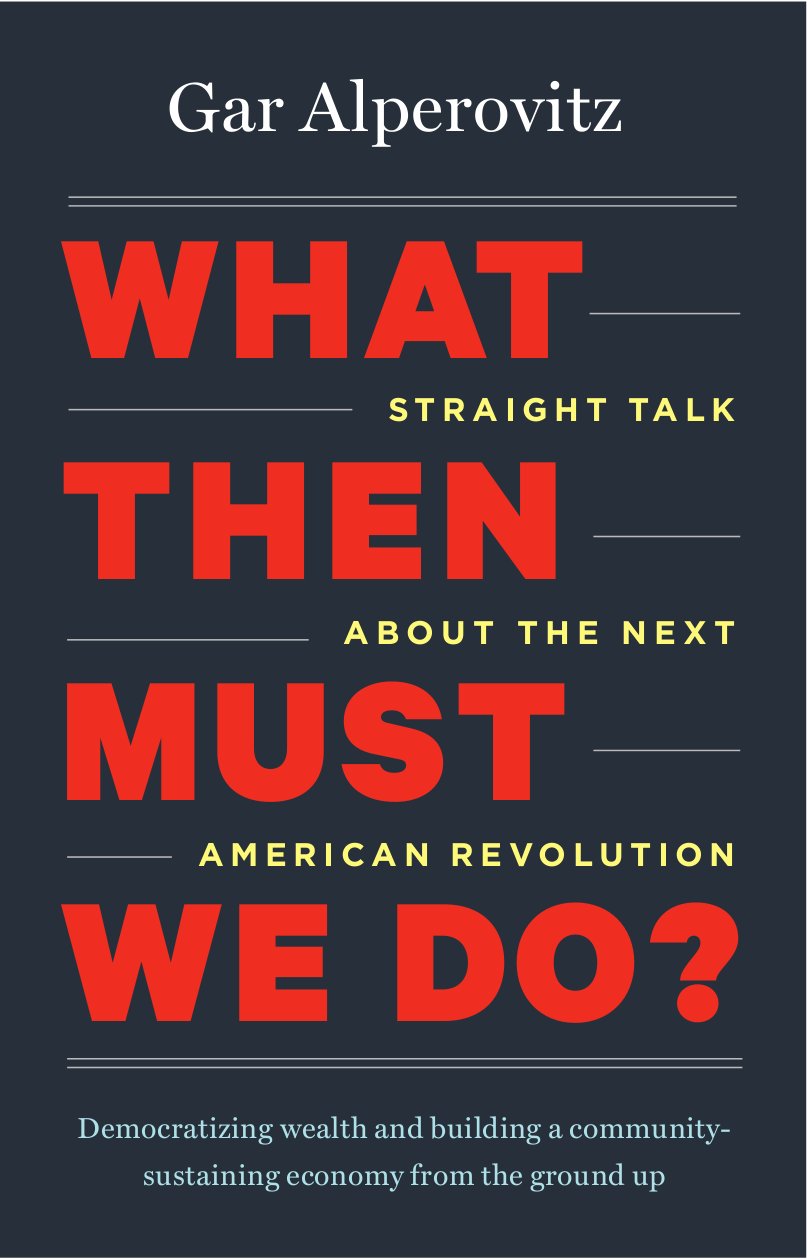
| My new film: available now | My new book: order now |
 |
 |
It is increasingly obvious that the United States faces systemic problems. Income and wealth disparities have become severe and corrosive of democratic possibilities. Unemployment, poverty, and environmental challenges deepen day by day. Corporate power now dominates decision-making through lobbying, uncontrolled contributions, and political advertising. The planet itself is threatened by global warming. The lives of millions are compromised by economic and social pain. Our communities are in decay.
Is there any way forward?
In this accessible introduction, Gar Alperovitz and Steve Dubb outline the principles of an emerging alternative system, one based on projects emerging all across America which democratize wealth, decentralize power, rebuild communities, and help create a sustainable future.
 As Mitt Romney and the Republican establishment continues to attack President Obama for daring to claim that business owners depend on public infrastructure to make a profit, many commentators on the left are pointing out the irony of how such and such Republican business person decrying the “you didn’t build that” line received such and such direct subsidy from the government. But this misses the larger point: in a technologically advanced society like our own, gains in productivity are overwhelmingly attributable first and foremost to the rapidly growing common inheritance of human knowledge, a point I explored in depth in my book with Lew Daly, Unjust Deserts.
More about the book: Unjust Deserts: How the Rich Are Taking Our Common Inheritance and Why We Should Take It Back
Podcast: A discussion of Unjust Deserts at Washington, D.C.’s Politics and Prose:
[ Download this segment * Subscribe on iTunes * Podcast link ]
Article in Truthout: How the 99 Percent Really Lost Out - in Far Greater Ways Than the Occupy Protesters Imagine
The biggest “theft” by the 1 percent has been of the primary source of wealth - knowledge - for its own benefit.
Knowledge? Yes, of course, and increasingly so. The fact is, most of what we call wealth is now known to be overwhelmingly the product of technical, scientific and other knowledge - and most of this innovation derives from socially inherited knowledge, at that. Which means that, except for trivial amounts, it was simply not created by the 1 percent who enjoy the lion’s share of its benefits. Most of it was created, historically, by society - which is to say, minimally, the other 99 percent.
Interview about the book: Dissent Magazine
Basically the story is that we have moved from a labor-intensive, small-scale farming economy to a knowledge-based information economy. In the process, the sources of growth have changed, but it’s important to understand that individuals have not really changed. We work no harder today than our ancestors did in 1800 or in the ancient past, and just the same, we are no more intelligent, in terms of basic brain capacity and reasoning ability. The cave paintings of earliest human culture are works of roughly the same basic intelligence as the theory of relativity. Let’s hold that thought: Essentially, we work no harder and are no more intelligent than our ancestors from the near or even the ancient past.
And yet our economy is more than 1,000 times larger than it was in 1800, and the best measure of prosperity, per capita Gross Domestic Product (GDP)—the amount of output the economy generates for every person—is twenty times higher today than it was in the early nineteenth century (it was $42,000 in 2006, the equivalent of almost $170,000 for a family of four). The key to this growth, experts agree, is rising productivity, usually measured in terms of the amount of output per hour of work, which rose more than fifteen-fold since 1870.
I had the honor of being invited to speak to the audience of the New Economics Institute’s “Strategies for a New Economy” conference from June 8-10 at Bard College in New York:
Gar Alperovitz - Our Time in History: The Possibility of Fundamental System Change from New Economics Institute on Vimeo.
Available now from Chelsea Green Publishing
More info about What Then Must We Do?
Preorder now via Amazon
Preorder now via Indiebound


 Agenda
 Posterboard